Friday, August 29, 2008

Visiting Farmers

One of the best, perhaps the best, thing about the work I do is going to the field to visit with farmers. Over the last year I have become fascinated and enthusiastic about agriculture, but particular in the people who engage in it. I love farmers. I put farming up with teaching as the two positions in society which should get extra high pay because their work is for the public good: teachers because they create an educated society, and farmers because they care for the land.

The best part about working with farmers is that they are amazing people. Incredibly warm, generous, humorous, and humble. It is really easy to stay motivated to work hard on a daily basis when you know you are doing it for such people. You just want to return the warmth they so naturally and effortlessly show you. So far I have done only a little work for farmers in Gujarat, but they are very appreciative of even that. It is something special for them to know that of all the things in the world an NRI Gujarati kid can do, he has chosen to come back to do work that tries to help them. This summer, I caught wind that I have become known amongst a wider circle of farmers than I have met myself, some have discussed our work amongst themselves. Pareshbhai, one of my co-workers at DSC, even mentioned that this summer's work will make my name known throughout rural Gujarat. How amazing!
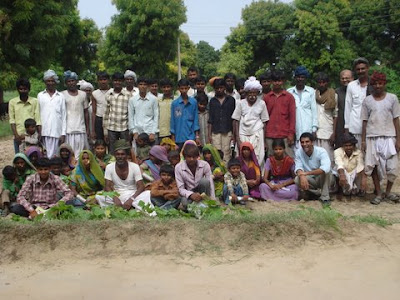
Over the past two summers, I have gotten to know many farmers. In fact, I would venture a guess and say I personally know about 100 farmers in Gujarat. And among them are some of the most thoughtful and progressive farmers in all of India. I've written about Sarvadamanbhai before, who I believe has the most advanced farm in Gujarat. I've visited big farms, small farms; organic farms and chemical farms.

A couple weeks ago I did a field visit with Pareshbhai and my manager from IBM, who visited DSC from Delhi for a few days. My manager afterwards said the day (which went from 6am to 1am) was "a lifetime experience". I know what he means. Anyway, I wanted to tell in words and pics about some of the memorable stories from the field.

We traveled about 600 km in total in the day, and went to really remote villages. At one point we were 25KM from the Pakistan border!

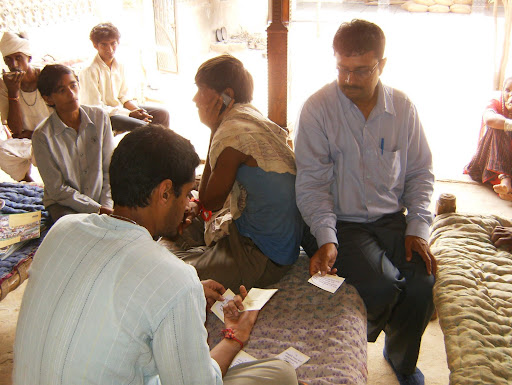
Our goal for the trip was to meet with farmers and discuss how they access information about their agricultural practices, what information they need, how best to deliver it to them, and challenges they currently face in accessing it. We did this in many ways, including free-form discussion, and a questionnaire I had prepared. We went to three villages, and in each place local farmers had organized meetings so that we could address a group. This pic is of the biggest meeting of the day, in a village called Beyok in Banaskantha jillo (district):
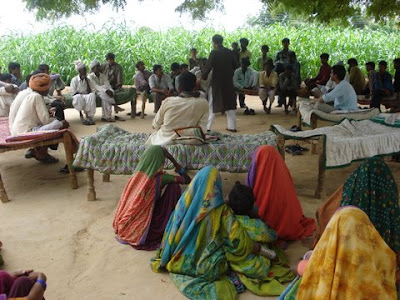

Notice how they set up the cots and sat around us in a circle. Also interesting was that the ladies, whom we expressly invited to be a part of our meeting, all sat on the ground outside of the circle.

We also discussed the radio program and what they thought about getting information over the phone. Then we went into specifics about our project. I prepared a paper prototype of the voice user interface that we have designed:
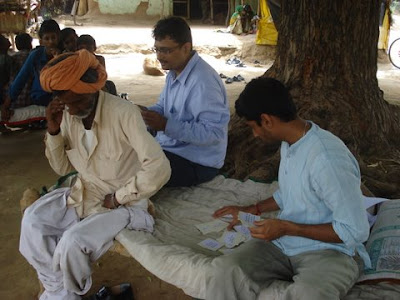
We had a bunch of flash cards with each of the voice prompts that the user would hear when they dialed our system. We asked the farmer to put a phone to his ear (which was off) and sit with his back facing Pareshbhai, who would act as the voice on the phone. Notice that we purposely had Pareshbhai speaking from behind to block any visual communication. I acted as the "computer", handing flashcards to Pareshbhai based on the participant's utterances. So if the user said "question", I handed Pareshbhai the prompt that said "Ok, you have chosen to ask a question. About which crop?" And so on. Explaining what we were trying to do itself was a challenge. It takes the ability to abstract in a particular way to understand that this was a mock version of a real system we would later build. We ended up calling it a "naatak" or "play performance".

We did the naatak several times, with some very interesting results. People were nervous, and some didn't get what we were doing, but on the whole we concluded that the basic interaction is going to work. In our third village, we met a women-only group and did the naatak:
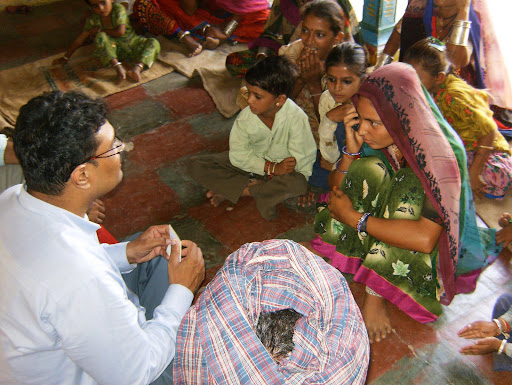
This was totally fascinating. We learned that the ladies don't own phones themselves, and rarely use them. Moreover, they are very intimidated by the phone, expressing that they were not educated enough to even dial a number.

Doing the naataks made me wonder whether we were doing something completely new. After thinking about it some more, I've come to believe that we are designing the first ever voice interface in the Gujarati language. Cool!

The final story I wanted to share is about a farmer named Babubhai. Babubhai is 18 years old. He has been featured on DSC's quarterly magazine, Divaa Dandee (meaning "Lighthouse", a name given by a farmer) many times for his progressive farming practices. He has given speeches in front of high-level government bureaucrats without flinching in meetings organized by DSC. But the thing that amazes me most about Babubhai is that he is a born leader. Watching him interact with the other people in his village is a sight to behold. He commands the all-out respect of each and every person in the village, from the youngest to the village elders. He is a peer amongst the grown men in the village. They all go to him for advice about their farms, and he has no hesitation about telling them what to do. Also, it is clear that each and every person in his village are gushing with pride for him; they recognize that he is very special.
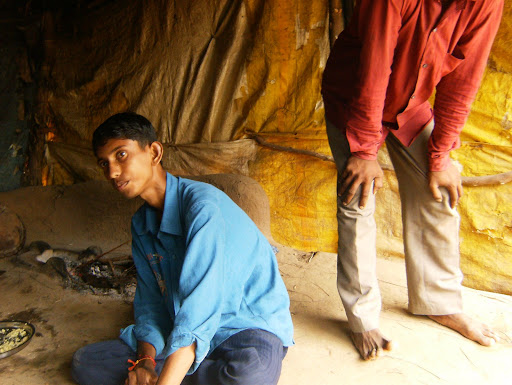
Babubhai is also an inventor, and he showed us the latest thing he has built:
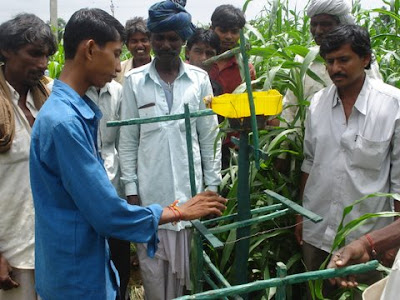

It is a insect trap that he puts out in his field. It is actually three traps in one. There is at the top a water bowl to attract birds, who in turn hunt around for bugs on the plants. Then there are posts on the sides to hang faramine traps. In the middle he has fixed a small light bulb that attracts insects, and right underneath it is where he puts a bowl of another trap which the bugs fall into. He told us that he wants to take his invention and share it farmers around the world.

I would consider Babubhai a genius, in the mold of Ramanujan. He is a diamond in the rough. I feel lucky to know him and work with him. Despite having only a gradeschool education, Babubhai plans on going to college and studying social work. I have very little doubt that he will eclipse anything I will ever do for the upliftment of rural Gujarat.

Tuesday, August 26, 2008

Kapilbhai-isms

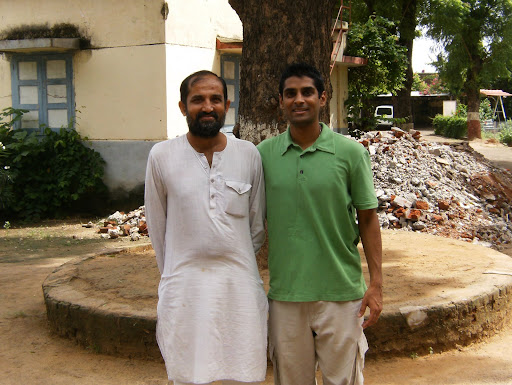
A couple weeks ago I went to Baroda for the long weekend to visit my Masi. I also took a day to visit the Vinoba Ashram where I lived last summer, and Jatan Trust, an organization working out of the ashram which I interned with. The heart, the soul, the engine of Jatan is Kapilbhai, who was eagerly awaiting my visit. Kapilbhai is one of my very few living personal heroes. His principles, the way he works, the way he lives, all deeply resonate with me and I admire him very much. Together last summer we developed an organic certification system for small farmers in Gujarat. Besides being the first and only organic certification in the Gujarati language (which means for the first time ever Gujarati farmers can actually read their issued certificate), there are many other aspects of the system that make it unique in all the world.

Just being back at the ashram and talking with Kapilbhai again in person, to be in his presence, gave me a wonderful feeling. I also enjoyed hearing him introduce Jatan and our project to some visitors who happened to be there that day. A highlight of this summer was when we were all sitting together, Kapilbhai looked at the visitors and said, "Neil is a great man." I was speechless and barely managed a reply: "No, I'm just lucky". It was one of the most meaningful compliments I've ever received.

I have rarely felt the pride for something I helped create like I did while listening to Kapilbhai talk about our work's guiding philosophies and how they have set us on a different path from what's been done before. To illustrate, he explained that in most certifications, organic agriculture's definition is reduced to farming without chemical fertilizers and pesticides. But JCS has a scoring system that we use to go way beyond this grossly simplified notion of sustainable agriculture. He explained as an example one of the criterias in our scorecard, which says that if your farm uses a tube well, you get 3 marks; if you use a canal, which is a little more sustainable way to get water, you get 5 marks; if you have a farm pond or check dam, that's even a better way to water you field, so that's 8 marks; if you don't water your field at all (that is, it is sufficiently fed just through rain), then you actually have the most sustainable (and advanced) irrigation system, so you get 10 marks. No other certification system in the world tabulates how 'organic' a farm is in this way.

Through the course of the day, there were a couple other nuggets of wisdom that Kapilbhai left me and this group of visitors, which stuck with me:

  1. "No one is poor until they sit in a car and drive around". This quote sounds weird because I don't remember the whole context of the illustration he was making, but the point was that poverty is a conception, an idea in the mind. You are not poor until you decide that you are poor. In India, as Kapilbhai pointed out, "many people go to sleep at night with an empty belly, but they are happy." To a western person's ears, this is a heinous comment, blasphemous. But I think there is something deep in it. The very definition of happiness, what it means for each person on the earth, is a very relative thing. We assume that a person must have a certain way of life to be happy, but happiness is a slippery thing. Sometimes you mean to bring about 'development' in a community, but you may introduce as many (or more) problems than you solve. Like in the "Gods Must Be Crazy".
  2. "If you've achieved short term success with a rural development project, you've done something wrong." Kapilbhai believes that working with a rural community is a lifelong task. It takes giving yourself fully, giving your life, to the cause and die trying to make a difference. For him it's the only way to roll: all out. I wouldn't take his quote literally, but what it means to me is that this work is not about cute little summer projects. If you are really commited to farmers and making a difference for them, you need to live with them and work as one of them. There are no shortcuts, and you shouldn't be in it for the awards or recognition or anything else like that. I couldn't agree more. I know that my way of working is exactly what he's railing against, and I am just too damn attached/scared/egotistical to go all out. But maybe one day.

Monday, August 11, 2008

Stuff Indian People Like #1

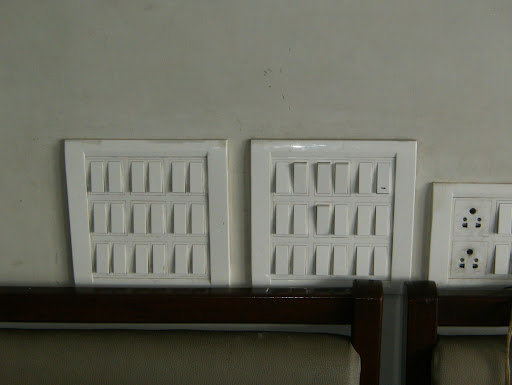
Lots of indistinguishable wall switches.


With these astonishing control panels, you can easily fall into the tedious ritual of toggling every damn switch to find the single one for the fan that you want. I wish there was a electricity-wastage impact study on this when multiplied by the millions of such rooms all over India.

And yes, you guessed it: this is the blogosphere's most exciting new running segment. We are going to give those white guys a run for their money.

Friday, August 8, 2008

Paying the Bills

This is my least favorite post to do, but it needs to be recorded for the sake of completeness: What am I working on this summer?

As I mentioned earlier, I am interning at IBM research Delhi, working with a team there that has developed a pretty interesting technology. The premise is the following: The WWW is great, but to really leverage it you need the Internet as well as the ability to read and write (...English). But believe it or not, most people in the world don't have one or both of these things going for them (the number of illiterate people in the world is more than double the number of those online).

But what a lot more people have access to is the telecom network in the form of cellular connectivity. So while the text-based web has a lot of reach, a voice web could give access to billions more. By voice-web (the IBM team calls it 'spoken web'), I mean content accessible through a mobile phone that is audio only; instead of websites, there are VoiceSites. For example, imagine Wikipedia set up as a VoiceSite, where instead of reading about check dams, you can listen to an audio version. VoiceSites can be linked to one another, and can be navigated with a broswer using HSTP (HyperSpeech Transfer Protocol).

The IBM team I am interning with has developed this technology, and I have come in this summer to try and understand how such technology might be applied in concretely useful ways. My previous work has been in the domain of agriculture, so I started looking there. One of the things I've known for some time is that agricultural extension, the process of adapting agricultural research to local contexts through farmer education, has for some time been utilizing radio as an effective medium for information dissemination. Radio isn't the sexist technology, but it is quite well-suited for rural development: it is cheap, flexible (hardware is lightweight, portable), familiar, can be localized (through community radio), and works well in oral and non-literate communities. But a big challenge is to make radio more interactive. More generally, it has always bothered me that in social/NGO sector, rural communities are only looked at as consumers; consumers of services, products, even information. But how can they also be made producers? Many farmers I've met have a lot of useful wisdom to share, and even at the the base level social services should be getting feedback from their constituencies on whether they are delivering their services satisfactorily.

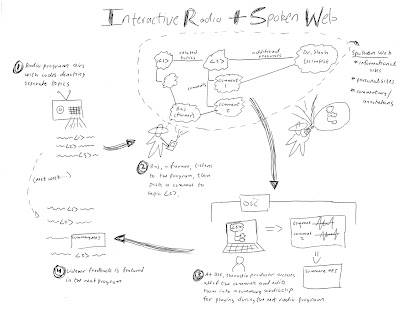
So this idea of spoken web + community radio + feedback channel developed, and we are now working on a project that tries and make this vision come to life. Specifically, I am working with an NGO in Ahmedabad called Development Support Center (DSC), which among many activities centered around promotion of natural resource management practices in Gujarat, has a weekly radio program called "Sajjata no Sang... Lave Kheti Ma Rang" (Sajjata no Sang is a network of development NGOs in Gujarat... "They bring color to the farmlands"). Our goal is to develop a model for social communication (sharing of knowledge and experiences within a community) and information access through interactive community radio. Using the spoken web technology, we will create a system for farmers to call in and leave any feedback (questions, comments, personal experiences) to DSC. Other farmers can listen to the feedback and respond as can DSC staff and/or any interested expert scientists. Conversations can build amongst farmers and with experts, experiences can be shared, and questions can be answered in a distributed manner. Additionally, we will provide an interface for the farmers to access all of the last 2 years worth of radio programming content; the information is now at their fingertips. Finally, all the feedback submitted to the system is recorded for DSC radio broadcasters to later export and play straight away on a future radio program; this sort of completes a loop where before, the radio program was a one-way broadcast. A more engaging experience and a greater sense of ownership develops now that the farmers hear their own voices. This sketch is something I presented early on to describe this full-circle vision.

As a researcher, my goal will be to design a voice-UI that is simple and user-friendly for the farmers. The spoken web system should be intuitive and navigable all through simple spoken voice prompting. We will to the furthest extent possible involve farmers themselves in the design of the interface, testing our system and incorporating their feedback early and often.

Working with DSC has been great. It is my first experience working in a formal NGO (office, 50+ staff, etc.). Every day there are mandatory chai breaks at 11am and 4pm. It is a time for the group to sit together, chit-chat, bond, etc. There is a dining area where most people eat lunch from home-brought tiffins. Sharing food is the norm. People even feel offended if their contribution was not finished by the rest of the group.

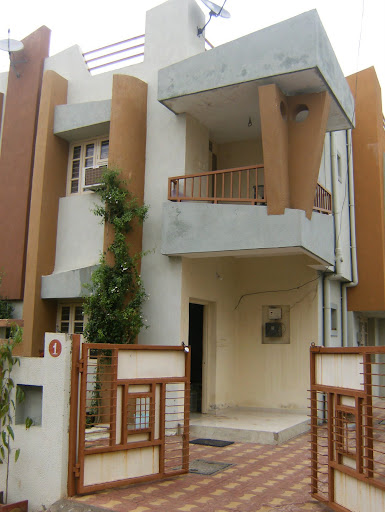
I'm living as a PG (paid guest) in a bungalow just 5 minute's walk from my office. I am staying there with one Indian guy working in Ahmedabad, and Kareem, another DSC intern. Kareem is from Canada and just graduated from college. He's here on a project dealing with participatory irrigation management and will be staying for 7 more months. He hasn't been to India, and he's a relatively timid person, so I've tried to show him the ropes. In some sense I've taken him into a mother-child relationship, making sure he's fed, getting his clothes washed, helping him get items for his room, etc. I'm a little worried about how he's going to survive, but hopefully I will have helped him get stuck in by the time I leave.

Sunday, July 27, 2008

4-Shower Day

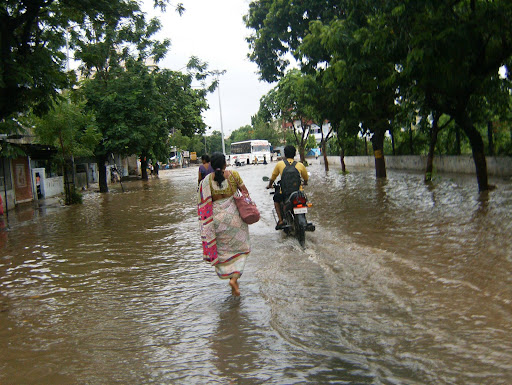
I bathed four times today. I woke up and took my normal bath at Ba's house. But overnight it had rained tremendously and the streets were flooded. Since I was in Naranpura, I was in some sense stranded from my office, which was on the other side of the city. The roads were not drivable. So I waited, hoping the rain would stop and the water would recede from the streets. At the first sign of letting up, I took off for the office. My goal was to catch a rickshaw, but the streets were chaos with vehicles trying to trudge through rivers/streets.

Shower #2: Trudging through a street in knee-deep water, which would better be described as wet filth. All the garbage, shit, and dirt from the surroundings combine into one cold and frothy soup. And I'm walking through it trying to find a street that a rickshaw could actually drive on. At one point a car comes speeding through and throws water all over me. Disgusting.

I was eventually able to grab a rickshaw and made it to my office. But I felt that it was necessary to clean myself, so I went back to my bungalow and had shower #3 for the day.

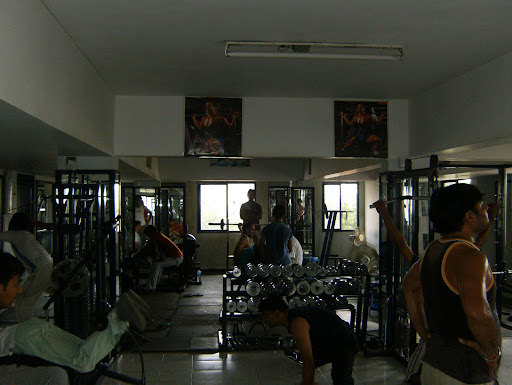
Shower #4: I've found a gym in Ahmedabad! If you've talked to me about my travels to India, you probably know that one of my biggest difficulties is finding a place to exercise, particularly to do weight training. Last summer I brought some resistance cables and tried to do a jailcell workout with the cables and pushups and pullups, but it was pretty unsatisfactory. So imagine my excitement when I became a card-carrying member of "Be Fit - The Gym", an establishment right next to my home and office (no, there isn't an actual card)!

Going to the gym in India is a totally different experience. First, there are set hours of operation. There is a time slot of 4 hours in the morning, 4 hours in the evening, with the middle of the day reserved for ladies-only session. This is a big change from my 24-hour Fitness at home, but should be manageable.

My fellow gym-goers are hilarious. Many come in dressed in jeans and regular shirts like they would be wearing on the street. Also, close-toed shoes are completely optional. I would say half the people wear chapals, with another 15-20% going barefoot altogether. Nuts.

The gym itself is on the third floor of a fading building. The first day I visited the gym I noticed a chalk board in the stairway that randomly had the message "prepare for the worst, hope for the best." I laughed because that's exactly how I felt at that moment. The weight area is impossibly small. In true Indian fashion, your personal space is totally restricted while exercising. I'm doing pullups and my feet are in the face of the guy doing bench-press. Benches are right next to each other, curling bars and weights are scattered everywhere. The equipment itself is worn down to say the least. I can't read the weight amounts of most of the barbell weights because all the writing has faded. Combined with the fact that everything is in kgs, I have no idea how much I'm lifting in most cases. All of this made me feel like I was in Rocky 4 training with inferior equipment in Russia. Another interesting thing about working out in India is the culture of spotting, which I will just describe as "over-zealous". As I've explored earlier, Indian men are quite touch-feely. In the gym, this is reflected in how people give "support" (that's what they call spotting here). It seems to me that every opportunity to get extra close, cop a feel, etc., are taken. When you are being supported on the bench press, instead of having the spotter at your head next to the weight rest, they straddle the lifter and spot from the front, with crotch right in the lifter's face. When I've gotten support, I also get loud and enthusiastic yelps of encouragement. "Come onnnnnnnn!!! Andddd... THREE!... yeaaaaaaaa !!! come onnnn UPPP!!!". Desi-style meathead.

The worst part of the gym is that there is horrendous ventilation. There are a few fans blowing here and there, but after about 15 minutes of working out I was drenched in sweat. That was shower #4.

The best part of the gym are the steroids-era 80s bodybuilder posters everywhere on the walls, which are a comical contrast to the skinny brown people actually walking around the place. Also, I have inspired one of my co-workers to take on regular exercise, so he signed up with me and is joining me on my every-other-day schedule.

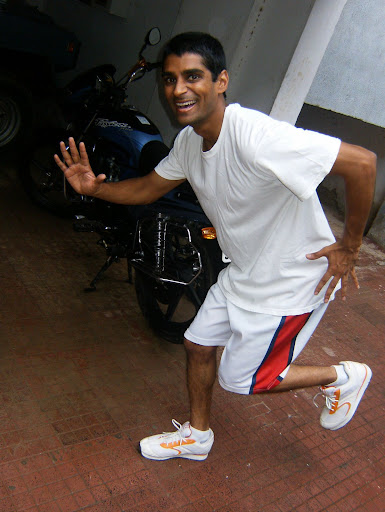
Finally, I went to RelianceMart to buy gym clothes, since I didn't expect that I'd need them when I was packing for my trip. I made a point to buy the ugliest shoes available and the longest shorts, and this is what I ended up with:


Wednesday, July 23, 2008

Lead, Listen, Destroy Walls...

Random thoughts that have come to me while in meditation, sitting in Chaghardas around Ahmedabad, and in the course of daily life:
  1. Leadership Universities. Since I was quite young I have had a vision that in my life I should be a leader of some sort. But leading is hard. I think there should be institutes of higher learning dedicated to training aspiring leaders. I wish I had a B.S. in Leadership Science. There would be classes like "Listening", "Scenario Assessment", "Working Under Pressure of Time and Constrained Resources", and "Delegation". Kids in the U.S. go to name-brand schools to be next generation leaders of the world, but for the most part it's a poor fit with their actual abilities and goals. They just happen to have been born in the most privileged society in the world so they have access to the resources. But a degree in leadership is only half the battle because of course we know that "...men don't follow titles, they follow courage".
  2. In a room full of people having a discussion or debate, the tendency is to assume that the smartest/most capable are the ones who have the broadest experience, know the most facts about a particular topic, are the most eloquent in expressing their viewpoint, etc. But in that same room I would say the one with the greatest potential is the dude who asks the best questions. There are two reasons. One, because by asking a question during heated discussion they have demonstrated that they have overcome their ego by avoiding the tendency to prove their intelligence by offering an ignorant, uninformed comment. Two, because they have demonstrated through the good question that they have gotten to the heart of the matter. It takes a sharp, astute mind to ask good questions. My adviser Scott asks particularly good questions.
  3. Four traits that I admire in other human beings and strive to perfect myself:
  • Fearlessness. I admire those who are able to break through barriers that come in their way in the course of life. Most people come to a wall in life and either live within it or at best decorate it to their taste. But the special fearless few are able to look beyond walls.
  • Humility. The ego is such a difficult thing to overcome. Here I have seen that my ego is very much alive and kicking. What to do? In retrospect I still feel that my ego-driven actions were right. But the trick, as I see it, is to take ego-detached action. It may turn out to be the same action as with the ego, but when you act humbly, you are free. Gandhiji had a quote that has stuck with me since I first read it many years ago: "The seeker after Truth should be humbler than the dust. The world crushes the dust under its feet, but the seeker after Truth should so humble himself that even the dust could crush him."
  • Compassion. Enough Said.
  • Gratitude. In college a saying came to me one day: “Every breath, a blessing”. My roommate here in my bungalow had a brain tumor removed. He is lucky to be alive. I am lucky to never have had a brain tumor. I wish to act, moment-to-moment, with that awareness.

Monday, July 21, 2008

The Brown Knight - I lowe Heath Ledger and Mike Jack

I'm in Ahmedabad! I arrived last Thursday, and will probably write something about what's going on here later. For now I wanted to talk about the topic of the day: The Dark Knight, the most phenomenal movie I have seen in quite a long time.

A group of friends from the U.S. who are here in Ahmedabad got together to see it together on Sunday night. We went to one of these megamalls that are everywhere in the city now. Big, shiny, full of young people... surprisingly quite an enjoyable atmosphere. Naman picked me up in his battle-scarred Maruti Alto, which he handles pretty well except for that fact that he is a big wuss with the horn. I realized that using your car's horn is part of what constitutes safe driving in India, since it indicates your car's presence in tight spots and blind turns.

Before the movie, we hung around in the mall for a while and went into a computer gaming parlour where we played some Call of Duty 4 on the LAN. I felt like a 12-year-old. Then we get in the movie and I realized I love watching American movies in Indian theaters for the following reasons:
  • Assigned seating. You don't have to worry about getting to the theater early for good seats because you reserve an exact seat. We had the best in the house.
  • They were playing Michael Jackson "The Girl is Mine" before the movie started. That really got me amped.
  • There were small jokes and subtleties in the movie that only an American/English-speaker could get. For example, no one got it when the batmobile flew into the parking structure at the beginning and set its mode from "Loiter" to "Intimidate". At points in the movie like that, Naman and I were the only ones in the packed theater laughing. We also were probably the only ones who knew the Batman back stories, like who Harvey Dent was from the very beginning. Oddly, all of this made me feel special/privileged like I had some sort of insider knowledge of the movie that others weren't cool enough to have.
  • Intermission. Of course American movies aren't meant to have breaks in the middle, so it stopped in a pretty awkward place. But it worked in this case because the movie was so good that it just made our anticipation for the rest of the movie multiply as we discussed with looks of disbelief at what we were watching. During the intermission they played "The Girl is Mine", "Thriller", and "Beat it". Naman and I were jamming to the music in our seats. Combining that with our high spirits from such an extraordinarily great movie, that had to be the most enjoyable intermission of all time. People around us were likely scared and/or annoyed.
As for the movie itself, I can't say enough about it. I can't remember my reaction to any other movie being, "I need to see this again right away." The acting, the story, the character development, the effects, everything was great. I didn't want it to end. Heath Ledger was just godly. Naman made the comment during the movie that the fact that he died making this movie makes his performance that much more impressive. It's a sad thing to say, but probably true. He should win all the awards for this performance, and the geeks at Slashdot agree.